


Over the past months, I have written a series of articles around one central question: how do organizations not only become high-performing, but remain high-performing by continuing to improve successfully? Drawing on a broad portfolio of academically published HPO case studies, these articles examine the mindset, governance, routines, and leadership practices that help organizations improve, embed that improvement, and sustain it over time. Several of the articles have already been accepted for publication, while others are still under review. Taken together, they form the research base for my forthcoming book, with the working title Built for high performance: Creating the mindset and governance for organizations that keep improving successfully.
One article defines the HPO mindset as a shared way of thinking and working. Managers and employees keep improving. They discuss problems and opportunities openly. They act with discipline on what matters most. They invest in long-term stakeholder value. They keep developing people and processes. In my analysis, this is not vague culture language. It shows up in visible behavior. You see it in leadership commitment, clear target-setting and follow-up, coaching, collaborative problem-solving, performance transparency, and continuous employee development across the five HPO factors.
What high-performing organizations do to keep improving
Two other articles focus on the front end of the journey. One identifies the prerequisites for getting started well: a compelling reason to improve, leadership commitment, readiness, ownership and enough capability to act. Another shows that a HPO Diagnosis only creates value when the results are translated into clear priorities, shared interpretation, explicit ownership and disciplined follow-up. In other words, a good HPO Diagnosis is essential, but without conversion into action it remains an interesting conversation rather than a real improvement trajectory.
A third group of articles examines execution. They explain why HPO transformations stall, how better design and governance choices reduce that risk, how performance steering and dialogue cadence together form one closed-loop governance system, and which practices shorten time-to-impact. Across the cases, the same themes keep returning: clear priorities, review cadence, measurement transparency, role clarity, internal HPO coaches, capability building, open dialogue and the discipline to finish what has been started.
Another set of articles looks under the hood of high performance. One identifies the recurring mechanisms through which HPO practices produce results, such as stronger alignment, ownership, execution discipline, learning loops and renewal. Another distils operating principles and transformation-design principles that help leaders turn the HPO Framework into daily routines, roles, dashboards, learning loops and decision rules. A further article reviews the evidence on causality and concludes that, while not every case allows strong causal claims, the stronger studies do show a recurring sequence of diagnosis, intervention, follow-up and performance improvement.
Finally, the series looks beyond improvement itself and focuses on durability. The articles on organizational grit and future-ready HPOs point to the same challenge. Sustained success depends on staying power. Organizations need to keep priorities alive under pressure. They need to maintain cadence and closure. They need to keep learning. They also need to adapt to change without losing control. In that sense, high performance is an institutional capability. It has to be built into the way the organization works.
How the HPO Governance Model turns insight into action
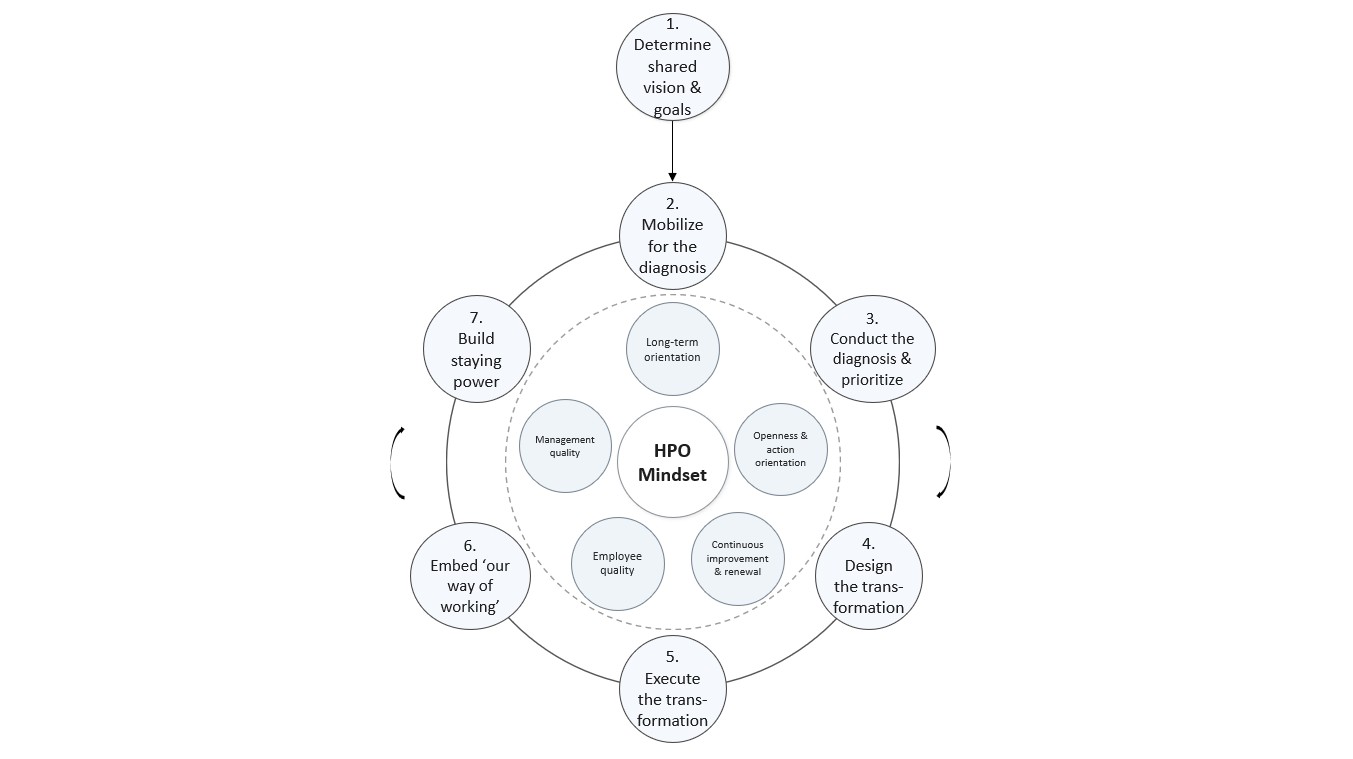
What does the combination of all these articles offer the reader? Above all, it offers an evidence-based answer to the practical question every leadership team faces: how do we build an organization that keeps improving successfully? The answer is captured in the HPO Governance Model that emerged from this research. The model links the HPO mindset and the five HPO factors to a seven-step governance path:
-
Determine shared vision and goals
-
Mobilize for the diagnosis
-
Conduct the diagnosis and prioritize
-
Design the transformation
-
Execute the transformation
-
Embed “our way of working”
-
Build staying power
This gives HPO a broader role. It is a diagnostic framework. It is also a practical roadmap for leadership, governance, and daily management. It shows leaders how to organize for high performance, how to accelerate improvement, how to embed it in daily work, and how to sustain it over time.
For leaders, executives and management teams, that is the real value of this article series and of the upcoming book. It brings together the mindset, governance and operating practices needed to move from ambition to action, and from temporary improvement to lasting high performance. When these themes resonate with an organization’s challenges or ambitions, the HPO Center can help translate them into a diagnosis, a focused improvement agenda and a governance approach that makes improvement stick.
For leaders, executives, and management teams who would like to stay informed about this research, the related articles, and the forthcoming book, André de Waal can be contacted through the HPO Center. We would be glad to keep you informed about new publications and the next steps in this line of work.