


Many organizations are good at diagnosing what needs to improve. They know which teams underperform, which processes slow them down, which leadership behaviors are holding the organization back. What is far harder is translating that diagnosis into lasting change. That translation is precisely where most transformation efforts quietly come apart.
At the HPO Center, we have been studying High Performance Organizations across the globe for more than two decades. A recent addition to that body of work, published in the International Journal of Quality & Reliability Management (de Waal, 2026a), focused on a question we encounter in virtually every HPO trajectory: why do organizations that are genuinely committed to becoming an HPO so often stall before they get there? The study drew on two evidence bases: a structured review of 45 academic studies on why quality improvement and change initiatives fail, and a comparative case survey of 54 scientifically documented HPO transformation cases from around the world. The aim was to map the actual failure dynamics organizations encounter in practice and identify the countermeasures that help keep a transformation on track.
How often do transformation initiatives really fail?
Before getting to the findings, one widely circulated claim deserves correction. The assertion that “70% of change initiatives fail” appears constantly in boardrooms and management literature. Our research (de Waal, 2026b) shows this number cannot be taken at face value. Empirically grounded failure rates, when defined consistently and measured over comparable time horizons, range from roughly 30% to over 65%, depending on how failure is defined and over what period it is assessed.
For HPO transformations, the definition is straightforward: failure occurs when the organization does not become and remain an HPO because the transformation stalls, fragments into disconnected initiatives, or is abandoned before new practices are institutionalized. That range still represents a serious risk. Knowing specifically what drives failure is considerably more useful than citing a round number.
Why HPO transformations stall
Across the HPO transformation cases in our study, the research identified three dominant failure patterns.
- Missing enabling conditions.
The leading failure reason across our cases was resource and capacity constraints. Not lack of strategic clarity, not disagreement on direction. Simply insufficient time, bandwidth, and focused attention to keep the transformation moving while managing day-to-day operations simultaneously. Close behind were poor fit and over-complexity: improvement approaches that looked coherent on paper but were too complicated, too ambitious, or insufficiently tailored to local realities. Many organizations attempt more than they can handle, and the transformation gets diluted as a result. - Capability and infrastructure gaps.
Both capability gaps and IT and data barriers ranked highly across our cases. The technology finding is particularly striking. In the broader academic literature on change and improvement, technology barriers tend to appear near the bottom of risk rankings. In HPO transformation cases, they rank among the highest. The explanation is plausible: HPO transformation work is closely coupled with redesigning performance management systems and improving information flows. When the data infrastructure is weak, when dashboards are unreliable, or when IT systems cannot support what the transformation requires, the ability to steer the entire effort breaks down. - Human and organizational resistance.
Employee resistance, weak buy-in, and low organizational readiness featured prominently across the cases. So did insufficient engagement of key stakeholders (the potential forerunners or ambassadors). Measurement weaknesses and leadership failures were identified in a similar proportion of cases as central factors in why momentum was lost: inconsistent sponsorship, leaders who did not demonstrate the expected behavior in their own work, and governance arrangements that gave way under competing priorities.
Taken together, these three failure patterns point to a consistent finding. The choice of improvement themes matters far less than organizations assume. What derails HPO transformations is the organizational system required to execute, sustain, and embed the work.
What helps an HPO transformation stay on track
The study also examined the countermeasures high-performing organizations used to prevent or recover from these failure dynamics.
The most frequently reported approach was strategy-linked performance management: dashboards, scorecards, and KPIs that kept strategic direction visible and made progress (or the absence of it) concrete and shared. Close behind was what the study calls execution cadence: a disciplined rhythm of PDCA cycles, quarterly reviews, and structured follow-up routines that converted plans into completed actions and generated learning. Together, these two approaches reflect a core practical logic: a transformation remains steerable only when there is a reliable feedback loop connecting strategic intent to actual execution.
Organizations that sustained momentum also combined several other elements. They simplified and phased their approach, running pilots before scaling and selecting a small number of priority areas rather than attempting broad change all at once. They invested in internal capability: leadership development, internal HPO coaches, and genuine empowerment of teams to problem-solve locally. Furthermore, they involved employees and partners in co-creating the approach, building ownership rather than imposing change from the top. And they worked to institutionalize new practices, embedding changes into onboarding routines, governance structures, and review cadences so that gains would not erode when leadership attention shifted elsewhere.
Psychological safety deserves specific attention here. Organizations that kept their transformations moving worked to create environments where problems could be raised openly, mistakes discussed honestly, and setbacks treated as material for learning rather than as grounds for blame. In practice, this meant structured reflection routines, incident reviews oriented toward improvement rather than fault, and leadership behavior that modeled the willingness to acknowledge difficulty. In the context of a multi-year transformation, these are genuine performance conditions, not peripheral cultural concerns. They are what keeps the learning loop working when things do not go as planned (and something will always not go as planned).
The research also surfaced a tension worth naming explicitly. A small number of organizations responded to quality risks by making individuals financially accountable for costly mistakes. The logic is understandable: clear consequences focus attention. The study notes, however, that this approach can simultaneously undermine the psychological safety and open error-handling routines that a learning organization depends on. Accountability matters, and results must be taken seriously. But when the response to mistakes shifts from inquiry to liability, the organization’s capacity to learn and adapt tends to weaken over time, exactly when it is needed most.
One further pattern in the data deserves attention. Capacity constraints are the most commonly reported failure dynamic in the entire study. Yet the most direct countermeasures (protecting time explicitly for improvement work, stopping or deferring other projects, creating genuine slack in the system) remained comparatively rare across the cases. Organizations find it considerably easier to add a dashboard, launch a training program, or set up a steering committee than to actually remove work and protect the bandwidth the transformation requires. The practical implication is direct: if capacity constraints are the leading cause of stalling, and explicit capacity protection is systematically underrepresented in the responses, this is a core design decision, not a peripheral project management issue.
Successful HPO transformation requires an HPO Governance Model
A significant insight from our research concerns how HPO transformation success should be understood. Individual initiatives, however well-designed, rarely determine the outcome on their own. What matters is whether those initiatives are assembled into a coherent, mutually reinforcing operating system.
Our study describes this as the HPO Governance Model, with seven interconnected components: strategic direction and strategy-linked metrics; governance and decision rights; execution cadence and review routines; embedding and learning loops; co-creation and communication; digital and data enablement; and capability building and leadership development.
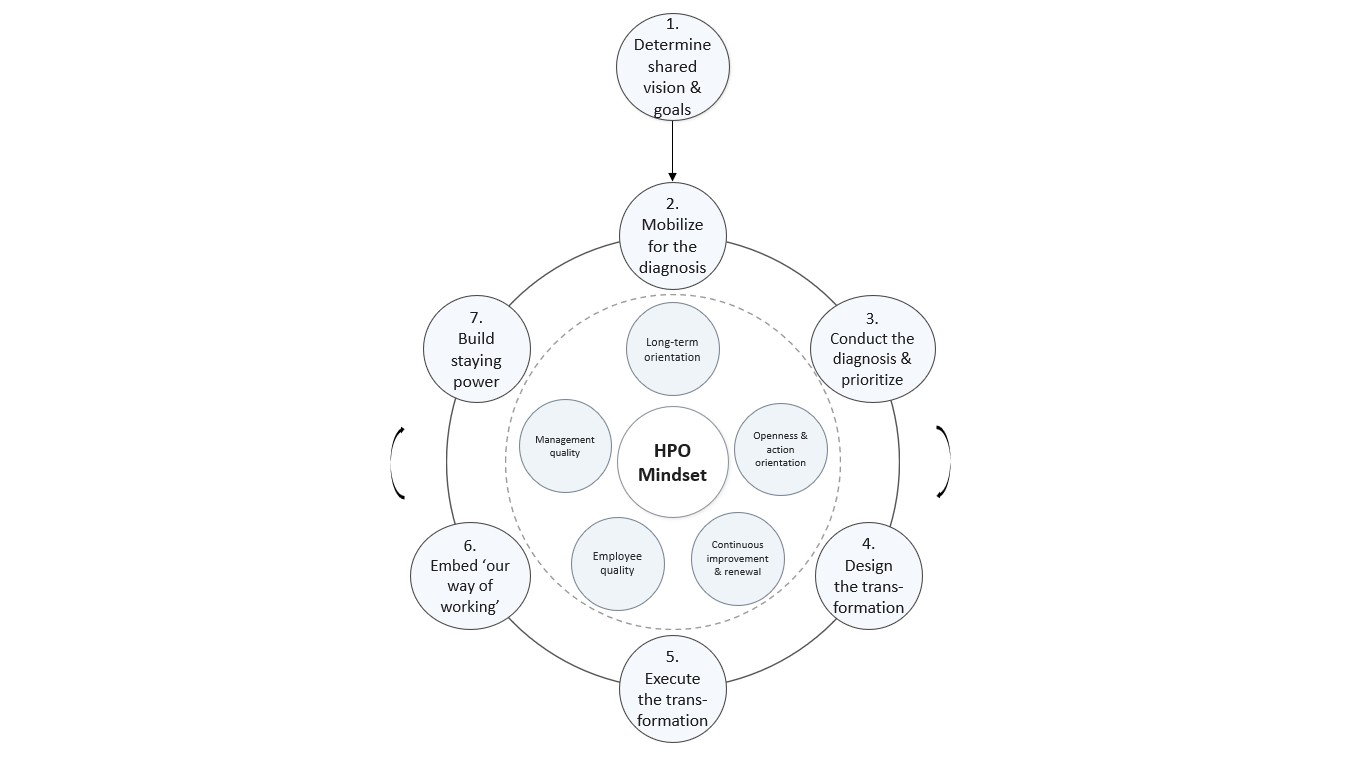
These components do not function independently. Strategy-linked metrics translate direction into priorities. Governance clarifies ownership and enables timely decisions. Execution cadence turns direction into disciplined follow-through. Digital infrastructure makes that cadence evidence-based. Capability building and co-creation make execution feasible at the local level. And embedding mechanisms ensure that what has been built does not quietly erode once initial energy subsides.
When any of these components is weak or absent, the system loses coherence. Plans do not translate into action. Gains do not persist. Leadership attention drifts. And what began as an organization-wide improvement effort gradually becomes a project that gets deprioritized.
The research also confirms that there is no single dominant playbook. The evidence points to a broad menu of practices that organizations combine differently depending on context. The consistent pattern is that the most effective combinations address multiple failure risks simultaneously and reinforce each other over time.
What this means for senior leaders
For executives overseeing an HPO transformation, the research translates into a small set of design priorities.
- Build the HPO governance model properly from the outset.
Metrics, review rhythms, clear governance, and internal capability need to be in place before the transformation scales, not assembled later as an afterthought. - Take capacity protection seriously.
Overload is the most common reason HPO transformations stall. Leaders consistently underestimate how difficult it is to create genuine time and bandwidth for improvement work alongside normal operations. Protecting that capacity, including stopping or deferring other work, is a core intervention. - Invest in psychological safety as a performance condition.
A culture where mistakes are punished or hidden is a culture that cannot learn. Structured reflection, honest feedback, and leadership that models openness are genuine conditions for whether the transformation can sustain itself over multiple years. - Treat data and IT infrastructure as foundational work.
If measurement systems cannot support reliable performance feedback across the organization, the transformation lacks what it needs to sustain multi-year execution. - Aim for a sustained trajectory, not a successful launch.
Early adoption is only the beginning. The real test is whether new practices are still functioning two or three years in, embedded in daily routines, governance structures, and the way leadership actually behaves. That durability is what defines a completed HPO transformation.
Working with the HPO Center on your HPO transformation
The findings from this research reflect what we see in practice working with organizations worldwide on their HPO journey. The failure dynamics described here are recognizable to most leadership teams that have tried to sustain a multi-year transformation. So are the countermeasures, and the gap between knowing what to do and actually protecting the capacity and governance to do it.
If you are planning an HPO transformation, or if a trajectory already underway has lost momentum, the HPO Center can help you think it through. We offer presentations and workshops on HPO transformation design for leadership teams, and work directly with organizations to shape, accelerate, and embed lasting performance improvement.
This article is based on the peer-reviewed study “Building the conditions for sustainable improvement: evidence from HPO transformation cases and failure research” by A.A. de Waal (HPO Center), published in the International Journal of Quality & Reliability Management (2026, DOI: 10.1108/IJQRM-01-2026-0038). The study synthesized 45 academic studies on improvement failure and analyzed 54 scientifically documented HPO transformation cases using a comparative case-survey design. An additional input is the article “Beyond the 70% myth: What do we actually know about failure rates in improvement and transformation initiatives?” by A.A. de Waal, published in the Journal of Engineering Management and Competitiveness (2026, DOI: 10.5937/JEMC2600001W).